
How Municipal Court Warrants Work
Elsewhere, a city ticket usually lands in a municipal or justice court that issues its own warrants. Minnesota skips that layer entirely. The case goes to district court instead, so the warrant stays a district court warrant even when a city officer wrote the citation. That does not narrow who enforces it. A Kasson or West Concord officer can execute the order, and a deputy can do the same in a contract city. The authority flows from statute and from the case itself, not from any city bench. Dodge County's one warrant court in Mantorville holds the file, sets the hearing, and decides release. It is also the only office that can recall the order. City hall never enters that chain. When a Dodge County warrant question comes up, the courthouse is the address that answers it.
Dodge County Has One Warrant Court
One trial court serves all of Dodge County. It sits in Mantorville. No justice-of-the-peace court exists here, and none of the six cities runs a municipal criminal court or a city warrant portal. That is structure, not a suggestion that cities lack rules. Cities still pass ordinances, and their police still write citations. The forum is what differs. A ticket may be issued inside a city, yet the case moves through the state district court from there.
Where to look: read the citation's court information first. If it names Dodge County District Court or carries a Minnesota citation number, the state court track applies.
The district court structure and jurisdiction are described on the Dodge County court page.
Municipal Courts Across Dodge County
With no municipal court layer anywhere in Dodge County, the city-by-city question shifts. The real issue is which agency wrote the citation. The record itself is filed with the district court.
| City | Police Service | Warrant and Court Route | Local Contact |
|---|---|---|---|
| Kasson | Kasson Police Department | Dodge County District Court | 507-634-3881 |
| West Concord | West Concord Police Department | Dodge County District Court | 507-527-2668 |
| Dodge Center | Sheriff contract service | Dodge County District Court | 507-374-2575 (City Hall) |
| Hayfield | Sheriff contract service | Dodge County District Court | 507-635-6200 (Sheriff) |
| Mantorville | Sheriff contract service | Dodge County District Court | 507-635-5170 (City Hall) |
| Claremont | Sheriff contract service | Dodge County District Court | 507-528-2137 (City Hall) |
Six Dodge County cities, one court. That structure is why a city clerk cannot answer a warrant question.
Dodge County Municipal Warrant Map
The Dodge County Sheriff's Office draws the map. Kasson and West Concord keep their own departments. The Sheriff holds contracts to patrol Claremont, Dodge Center, Hayfield, and Mantorville. Follow that split and the calls route themselves. In an independent city, the local police handle anything about the citation or the incident. In a contract city, the Sheriff's Office is the police contact, and city hall can only point you onward. Dodge County gives you two doors, and knowing which one saves a call.
The service map is posted on the Dodge County Sheriff's Office page.
Dodge County Municipal Warrant Checks
A city citation rarely stays a city matter. Once it is filed, any Dodge County warrant check runs through county and state systems. The city is just the first phone call.
- Read the citation for the court name, citation number, and hearing date.
- Look the case up in the state court case search by citation or case number.
- Call the city police department if you need the report or the issuing officer's agency.
- Call Court Administration at 507-624-7010 for the hearing and case status.
- Call the Warrants Unit at 507-635-6226 if the case shows a failure to appear.
Work the offices in order, and keep the citation number in hand. Without it, staff have to guess which case you mean. The county's published outstanding arrest warrant page is one more stop, and a payable city case can go through the Court Payment Center. Minnesota has no public statewide warrant search. So a Dodge County city case gets traced through the county list and the court file, with the citation number tying them together.
Where Dodge County Warrant Cases Are Filed
An ordinance case starts with a citation and ends in the same system as any criminal charge. Minnesota's district courts handle the filing, the calendar, and the record. In Dodge County, the Court Administration office processes the paperwork behind all of it. That office covers criminal, traffic, family, juvenile, civil, probate, and conciliation case processing. This is why an ordinance ticket gets answered by the court, not by the city that wrote it. The Dodge County Court Administration page lays out that role and lists the contact details. Note: If a city says a matter went to the court, the citation number is what lets the clerk find the Dodge County case again.
Municipal Warrants: What They Show
A city-related warrant in Dodge County is a district court record. Its fields follow the court file, not any city form.
| Case number | The district court file number, with a CR prefix for appearance cases and VB for payable ones. |
|---|---|
| Citation number | The preprinted number from the city-issued ticket, which is often the fastest way into the case. |
| Issuing agency | The city police department or the Sheriff's contract patrol that wrote the citation. |
| Violation | The ordinance or traffic offense, shown on the county list only as a short reason such as FTA. |
| Bail or release label | Dollar bail, Body Only, or Sign and Release, set by the district court judge. |
| Status | Open, paid, warrant pending, or cleared, which only the court and the Warrants Unit confirm. |
Dodge County Warrants and City Hall
This is the most common wrong turn. City hall can answer city questions, and the clerk can find a city record. Neither can change a court order. A warrant is a judicial act from start to finish. A judge signs it, a judge recalls it, and the court logs what happens next. A Dodge County city employee has no role in that chain, however the case began. So route each call by the question, not the address. City hall handles records and ordinance questions. The police department handles reports as the issuing agency. Court Administration owns the case, the hearing, and the order. The Warrants Unit gives the current status. If a caller posing as a city official demands payment over a Dodge County warrant, hang up and dial the county number yourself. That scam is well known in this region.
Clearing a Municipal Court Warrant
A citation the city turns into a warrant gets cleared like any other Dodge County warrant. You work through the court, not city hall.
Call before you travel: Minnesota's court FAQ warns that appearing in person with an active warrant can result in custody, so confirm the process first.
Call and ask before you act. For a payable ordinance or traffic fine, confirm the court still allows payment and whether a failure to appear was entered. If the case required an appearance, Court Administration can tell you what the file needs. When a warrant reads Body Only, talk to a lawyer before you set up an appearance. Once your appearance or payment is on the record, confirm the warrant was inactivated and ask when the Dodge County list will show the change. City hall will not know.
Dodge County Warrant Confidentiality Rules
A city citation does not change how Minnesota treats the record. The access rules are the same whether a state trooper, a Dodge County deputy, or a city officer wrote the ticket. Public data is presumed accessible under Minn. Stat. 13.03. Arrest warrant index data stays confidential under Minn. Stat. 13.82 until the person is in custody, served, or in court. Juvenile records are closed under Minn. Stat. 260B.171 except in listed situations. Dodge County's publication practice follows those rules, so a warrant can be active and still missing from the public list, and a city-held incident report is a separate record from the court case. Minn. Stat. 13.82 sets the rule that keeps unserved warrant data out of public view.
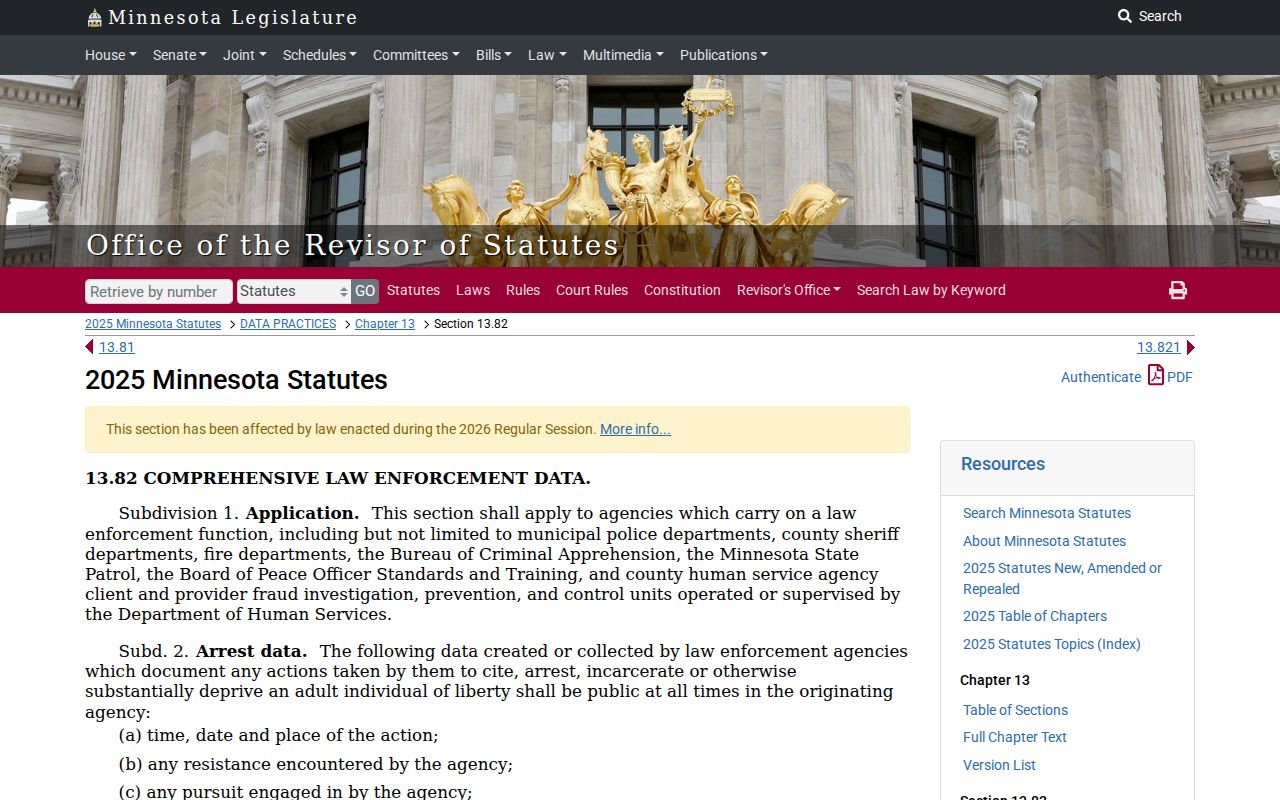
That statute is why a Dodge County citation can sit off the public list while its case stays open.